Friday, 13 February 2015

Studio

Anybody wishing to enter the world of professional photography will most likely have to take a studio portrait at some point. Although I have access to a fully kitted studio, I'd like to talk about home-studios, and cheap alternatives.


Depending on what you are doing, home studios can be made with household items, or with a little investment, a cheap set-up can result in a very professional look. My FiancĂ© purchased an amateur studio lighting set from Amazon for around £300, expensive still, but on the grand scheme of things that is dirt cheap.

The set included 3 flash lights (with continuous light), 3 flimsy light stands, soft boxes, honeycomb diffusers, barn doors, coloured overlays and a flash syncing device. I brought one of the lights off of her with each of the attachments for £100. I then went out and brought 2 meters of plain black fabric from my local sewing shop for around £15,  I then purchased an extendable net curtain rod and some plastic picture hooks, costing about £5.

So for £120 I now had a studio set up. I hammered the picture hooks into the ceiling, suspended the net curtain rod from them using string, then when I need the backdrop up I just peg the material to the rod.

This studio, although very cheap, gives a professional result and with a little editing, would be indistinguishable from a professional set-up.

If you do not have the money for this kind of set-up which frankly I wouldn't have been able to afford if it wasn't for student loans, then there are alternatives. My external flash is a cheap knock-off version of a Nikon Speedlite, costing £45. I also brought a universal external flash soft box for £10. The flash came with a tripod attachment, and some feet. With a flash sync, this external flash could be used as a studio flash, and yield great results. Especially in a small studio.

When photographing still life or smaller subject, homemade mini-studios can be made using little more than a towel and a lamp of some description, look around, you would be surprised what will work.

So that is the 'studio' covered, but what about shooting? I like to believe that we are not bound by rules, but with a little knowledge and some logic, there are common 'rules' that yield great results. With one light, it is easy to get a two toned image using light and dark, split across the face or at an angle, these shots can be very moody, especially in black and white. Just experiment.

Also, try to get catch-lights. Catch-lights, essentially, are reflections of the studio lighting in the subjects eyes; they make the subjects appear more genuine and heart-felt.  They always work with black and white images. If you are struggling to achieve catch-lights, they can always be added during post-production, but it looks more natural to get them in-camera.


This shot (above) is of my fiancé, it was a tricky one to get the catch-lights. After a long time messing with exposure and light positions, we 'collectively' decided her eyes were not shiny enough to reflect the light, so I held a lit incense stick underneath her eyes until they began to water and took the shot. Some might say cruel, I say determined.

To complete the shot I added an identical layer to Photoshop and added a blur filter to soften the skin. Then, using layers, I removed the blur from the eyes, to make them pop, and to create a fake shallow depth of field.

Keep Shooting and Experiment!


Alternatively follow me on Twitter at: https://twitter.com/AJTPhotographer

Mood

Moods and emotions are sensations all humans beings have experienced, regardless of  age, race, gender or beliefs. The ability to emotionally feel can often be a foundation for empathy, compassion, and spiritual connection, be it strong or brief.

The notion of Moods and Emotions is a fact of life, we are powerless to deny the existence of sense; and it plays a significant part in the journey we undertake as individuals.

Any day of the year, at any given moment, we as physical entities are feeling an emotion or mood. Weather we are in the presence of someone we love, or undergoing a task we hate, our thought processes and actions will be altered by the mood or emotion we feel. For instance, in the presence of love, we are generous, sympathetic and benevolent, however, while experiencing discomfort or anger, we can often be cynical, hurtful and selfish.

To avoid "bad" emotions, one must be extremely strong minded and selfless, it is exceptionally difficult to notice the overall value of something we loathe, or take into consideration those who have hurt you.

Emotions are an overwhelming ride though good and bad, and trigger evolution in ones personality, as they undergo their journey of life. The creative souls of humanity have been attempting to evoke emotions and capture moods through art since the dawn of humanity. In my opinion, the most powerful means of doing so is through music, however, imagery in paintings, photographs and drawings can be just as effective, but through a different sensory organ.

To capture a mood or emotion through art, the artist must have more than technical capabilities, the emotion lays behind the art, but is often the most important part of it. Frequently, the artist will express their own emotions through their art as means of expression and release. To me, this is one of the most interesting characteristics of the human race, and is the rationale behind my connection to art.

Photography is one of many art forms used to powerfully evoke emotions and thoughts in the viewer. From the black and white images of photojournalists such as Don McCullin and Robert Capa, to the Fine art and Surrealist photographer such as Sandy Skoglund  and Man Ray, photography is used as a commercial tool to provoke thoughts and emotions on the given topic.

Emotion can easily be emitted from a photograph of a moody subject such as destruction, happiness or defeat. In a sense, anybody with a camera can capture a mood that is blatantly apparent to those who are at the scene. For instance, a newlywed couple dancing on their wedding day is an unconcealed emotion of happiness; Families mourning the death of a loved one at a funeral, again, is an openly visible mood, which would show though a photograph taken by anyone.

Many photographers do shoot these kinds of scenes, but the more emotional photographs are often the ones that make the viewer think about the subject, and consider the emotion behind the image.
The image of a more subtle emotion often yield far more mood than meets the eye. The viewer is drawn to thoughts of what the subject means to them, what it meant to the photographer and why they photographed it. With images of less obvious expressive value, it is rarely the subject itself that has evoked the emotions, but more the style and techniques the photographer has used to capture the image.

The key is in the way the artist has photographed the scene, not how the scene appears to the naked eye. To do this, the artist has to consider many aspects of the subject. This is what is often referred to as the "eye". Photographers often see the world in a different way to others, which is what makes their work interesting, emotional and thought provoking. This, I believe, is when the artist has transformed from "taking photos" to becoming a "photographer".
 
The point of this blog is to remind ALL photographers, regardless of experience, that their photographs are art, they provoke emotions and thoughts in the viewers, and can sometimes represent something from the photographer.

Have you ever thought about what you would like to tell people through your images? Or perhaps just some emotions you would like to express. Many turn to the arts, and one way or another, photographers do too. Give it a go, try to really express yourself through photography.

For example, a close friend of mine, while undergoing a spate of depression, was photographing contemporary style images involving themes of being trapped, self hate and ultimately suicide. The images were extremely powerful, and even more so when you hear the story behind why the photographer shot them.

This is taking expressive photography to the literal. However, you may find that you are expressing yourself already, without even knowing it, like you are sub-consciously drawn to that photography because of your feelings or personality. My two biggest passions in life are Music and Photography, so it is no coincidence that I ended up becoming a music photographer. The other side of me is extremely passionate about environmental issues, and I have a love for nature and animals, hence my personal/hobby photography as wildlife and landscape.

My words of advice is find your niche, not just photographers, but all people, find what it is you love, what you hate even, find that passion, and express it. Most creative people will understand me when I say life isn't about paying bills. Do what you love, don't give up, with enough time invested, you will gain whatever you want from it.  

Thank you for reading, whoever you are 


Alternatively follow me on Twitter at:  https://twitter.com/AJTPhotographer

"Food"

Food photography is a very useful skill to have and also very fun to shoot, especially when you get the eat the food afterwards. I don’t mean a quick snap of you dinner from a restaurant on Wednesday night, I'm talking studio, still life.

For this task I was quite happy from the start, food is not exactly a difficult concept to interpret. So it was down the shop for a bamboo chopping board, 3 oranges, Cinnamon Sticks, Star of Anis and a Plain Victoria Sponge.

To begin this shoot I took the bamboo chopping board outside, and gave it a spray tan, using a butane blowtorch. I then scraped the sides of the board on the concrete, scratched the surface with a knife, and to complete the 'battered' look I threw a brick at it.

I then set up my studio area, placing some white A3 paper over a chest of drawers against a white wall. I then arranged the objects on the chopping boarding, using a tripod and a remote shutter. I lit the shots with a single studio light set to model, bouncing it with a piece of paper.

I tried a variety of exposures, using shallow and large depth of field, changing the composition and angles. The great thing about this kind of photography is you can set up the still life, and shoot it from every angle and using all the settings you want, and then change the subject and do it all over again. It would be impossible to explain my shooting method as it varied from shot to shot, once I have the camera off of the tripod.

Upon completion of the shoot I loaded the shots into Photoshop  as usual. Adjusting the Levels, Contrast and Clarity to get the image as close to what I had in mind. The only problem was some of the background was appearing an off-white colour. Using the Dodge tool I worked on this area repetitively until the background was a nice flat white.

Here are some of the images.


Alternatively follow me on Twitter at: https://twitter.com/AJTPhotographer

Thursday, 12 February 2015

"Levitation"

When it comes to photography, there has always been one area I have struggled to grasp, an area almost essential in modern photographic practice, Photoshop. I can quite comfortably work my way around retouching my images, but CREATING on Photoshop has sadly been a constant gray area. Despite having a strong like of Surrealism and ingeniously Photoshopped images, I have never managed to develop my skills.

So when the task of Levitation was set, I really had no idea what to do. This blog post is going to be reasonably short, with little more to talk about than bananas.

Yeah... bananas. My idea of a solution to a create block during the task of levitation. Despite being very unhappy with the image, I will show and explain, and hopefully give a confidence boost to others knowing that they could do a better job, and that ALL photographers have bad shots.

To do this shoot I set up a tripod in my kitchen, facing at a slight angle above the banana. The idea was that the banana itself would be standing on its peel, with floating cut out chunks. The whole standing on the peel thing didn't work, so excuse the strange appearance of a mis-aligned plate.


The first shot is of an empty plate. This was to be used as the base layer. Next, I peeled the banana and placed it on an up-side-down white ashtray. I then made cuts in the banana, taking a shot each time I made a cut, similar to making a stop motion film. I then thoroughly enjoyed the "fruits of my labour".

Simple as that with the shooting, time to edit. I shot this task in JPEG because I knew the exposure was fine, and I could not be bothered to save each one to JPEG during post-processing.
I opened a blank page on Photoshop, measuring 5000px by 5000px, giving me more than enough room to edit. I then loaded all of the images into Photoshop, and stacked them perfectly on top of one another.

I then hid all shots except the base layer and the banana layer. Using layer masks, I removed the ashtray and all of the banana fruit. I then added each layer one by one, working backwards to build the banana.

To do this I used layer masks, using a black brush to completely remove each layer, and then using a white brush to bring back areas of the banana. When doing this I needed the shot of the cut to be seen, I had to match the shape of that cut with each banana slice.
Once  the image was done I flattened the layers and altered the tones of the entire image. This is the result.


Alternatively follow me on Twitter at: https://twitter.com/AJTPhotographer

"Bokeh"

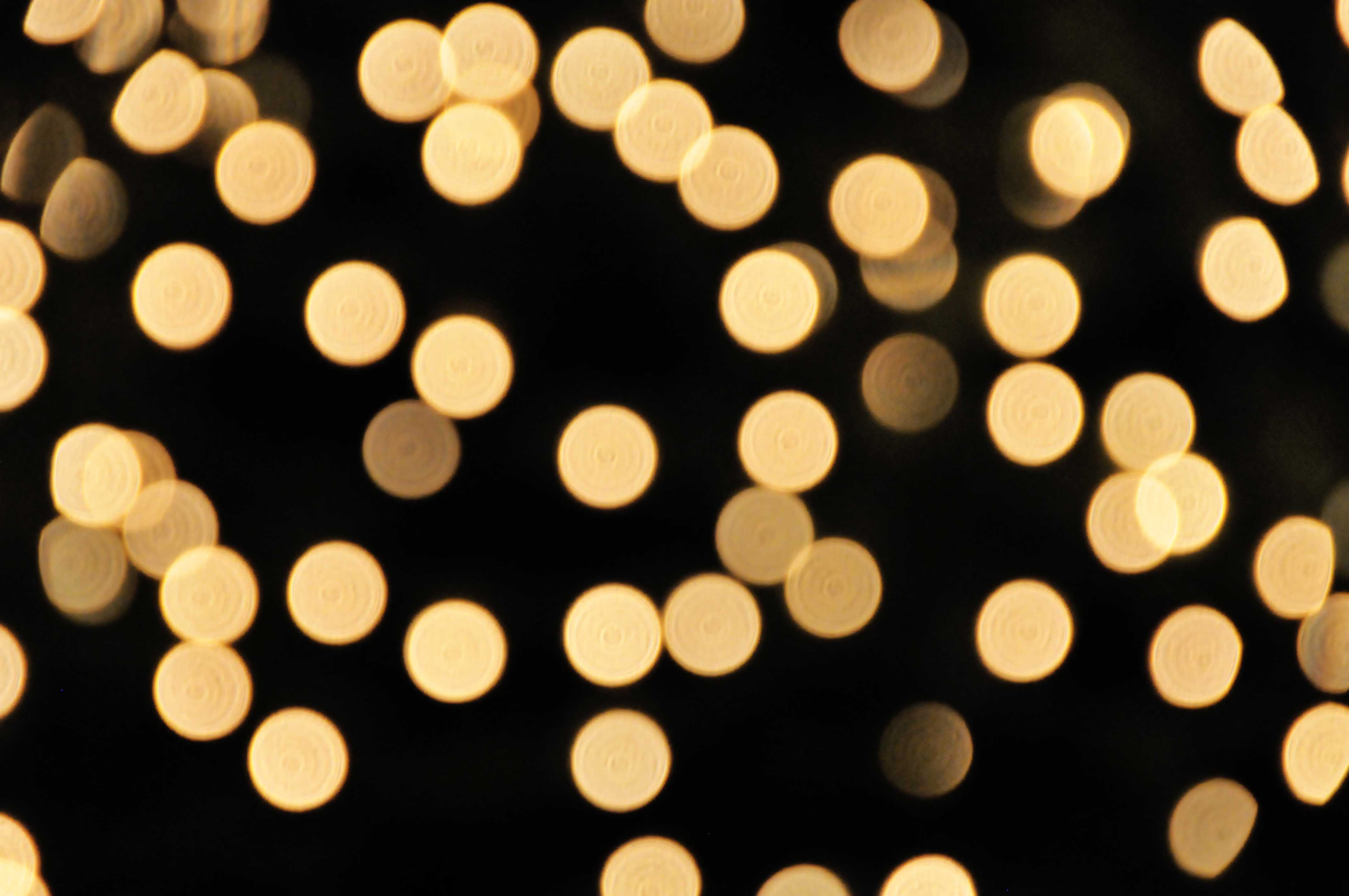
The Next  Challenge was "Bokeh". For those who may not know, Bokeh is a photographic technique used mostly in portraits. Bokeh is when the highlights of the background are so out of focus they become lots of circles. Although traditionally Bokeh is circles, they can also be pentagons and hexagons, depending on how many blades your aperture has. Sometimes bokeh can be morphed into shapes, such as little hearts or flowers. This is achieved by cutting out a shape and placing it over the lens. For the sake of professionalism and natural looks, I will explain 'natural' Bokeh. This image was found at http://fc08.deviantart.net/fs38/f/2008/362/b/e/bokeh_texture_by_ntscha.jpg

Bokeh is achieved by having such a narrow depth of field that the background becomes unrecognis

able, and the detail just becomes a flat area. Bokeh is generally achieved when the background has lots of individual highlights such as Fairy lights or a busy road.

As I previously mentioned, Bokeh is caused by an extremely narrow depth of field, depth of field is the area in which the image is in focus, a large depth of field means the image is in focus for the majority of the shot, such as a city-scape. A narrow depth of field means the focus range is minimal, and the background (or foreground) is out of focus. To achieve a large depth of field, an "Small" aperture is required, usually F/8 and beyond.

The trick to Bokeh, is having the aperture as wide open as possible. The average lens will go back to around F/3.5, although this is plenty for achieving a fairly narrow depth of field, this is usually not wide enough to create bokeh. A lens reaching back to F/2.8 or lower is going to do just fine. Alternatively, a Macro lens will create bokeh, but can be difficult to use for a portrait shot.

For this task I used an old manual lens, a 1970's Nikkormat F/2.8  50mm. This lens has an aperture ring, which means my Camera body's Computer cannot set the aperture, it has to be done manually. The focus was also manual, with no connection to my Camera AF mechanisms.
Having only been given a week to complete this task, and being unable to find a model for a portrait, I decided this task would be done as a still life shot. At that time I had no access to a multiple light source that was suitable to give me a good bokeh image, most were using fairy lights, however mine had sadly "expired" due to a small case of "clumsy twat"...and the spares had also managed to break themselves.

So I began searching for an alternative, which basically meant I sulked at my desk for half an hour before I realised the solution was right under my nose. On the desk lay a large piece of Cubic Iron Pyrite. On the reverse side of this crystal, lay a cluster of tiny shiny gold crystals. This cluster, upon illuminations from my studio light, would reflect lots of tiny, scattered highlights, giving me a perfect bokeh.

The golden shine of the Pyrite gave me a great tone and bokeh, I just had to find something to stick in the foreground, something that fitted the colour scheme. Being a man of little wealth I was yet again stumped. Until it struck me....COINS.
I emptied through what one might call a "Savings Jar", finding about 86 pence and an old roman coin I had purchased for 20p about 3 years ago. The roman coin was the obvious choice!
Propping it up with a (fake) brass chain, I composed the images, with my crystal in the background, time to think technical now.

The lighting was facing mostly dead on, to light both the objects and the background. I placed the objects on a Djembe Afican drum, with a black towel over the drum skin and stapled to the wall. Overall a basic setup with one light.

To achieve the bokeh, I set the lens' aperture ring to F/2.8 and had a shoot around, despite using my wide aperture of F/2.8, I soon realised that the objects were so small, that the crystal was peeping into my depth of field...while I realise now that I probably could have just moved the crystal, I decided to think a little outside of the box.

Having no macro lens to narrow down my depth of field, and no wider aperture available in my kit bag, I decided to detach my lens from the body, and hold it up to the camera body, with the focus ring wound all the way back. Using a combination of swaying further and closer to the object, and moving the lens further and closer to the camera body, I could locate a point though the eyepiece in which the image was in focus. This technique is known as "Free Lensing".

The problem with 'Free Lensing' is that light can creep through the gap between the camera and the lens, over-exposing and washing out the colours, to counteract this, you can purchase macro extension tubes. Connecting to the camera like a lens, and then offering a lens attachment at the other end. These tubes work in the same was as Free Lensing and cut out the light pollution, some extension tubes can even auto-focus.

Having no extension tubes at that point, I just had to find the right combination of lens-body distance and object - lens distance.

Another issue was my eyepiece focus component had been slightly knocked in my camera bag, leaving me able to focus through the viewfinder, but wondering why the resulting image was wrong. It took me a while before I realised my eyepiece focus calibration was off. To fix this I attached a new lens, using auto focus I locked focus down, and then calibrated the eyepiece, turning the cog until the shot was sharp. I was now calibrated and ready to try again.
Once I had enough shots, I loaded the images into Photoshop's RAW processing and began making tweaks. Firstly, I upped the exposure a tiny bit, bringing the overall shot to a decent exposure. Instead of adding contrast, I brought the Highlights and Whites sliders up a little. The darks were quite abundant, so I lightened the Shadows, but darkened the blacks, this highlighted some of the shadows, but darkened what was left, giving me lots of detail and some nice shadow.
I then increased the Clarity (Mid-tone contrast) of the overall image, and using the brush, exaggerated the clarity of the coin. I then warmed the temperature of the image slightly, and saved to JPEG. This is the Result.


Please feel free to add me on Facebook at:https://www.facebook.com/profile.php?id=100007321418710


Alternatively you can follow me on Twitter at: https://twitter.com/AJTPhotographer 

"Smoke Trails"

My first challenge was called "Smoke Trials". Requiring minimal thought into how to interpret this challenge, I decided I wanted to do something interesting with the results.

I had a few ideas in mind, but I will talk through the shooting technique before I talk about the final images, remember, this is a digital manipulation task, shots of plain smoke will not do.

There are endless ways you can shoot smoke, so don’t be disheartened if you are reading and you don't have the equipment to do this exact shoot, just remember to experiment, you will never know until you try.


For MY shoot, I used.

Nikon D7100
18-105mm (Kit) Lens
Tripod
External Flash (Mounted on a tripod)
Pocket Wizard (Flash Sync Unit)
Black Card
Incense Sticks
Bottle
Paperclip

Before you begin the shoot, make sure the area you are shooting in can be plunged in complete darkness, for my shoot, I used a Photographic Studio, just because I had access to one. If you don't have access to a studio, simply hang think material over your windows, or wait until darkness had fallen.

Place a table up against a wall, and cover the wall using black material of some description, don’t worry about the table, it wont be in shot, however if you have a reflective table surface, it might be worth covering with a towel.

Using card, black if possible, cut out paddle-like shapes (SHOWN) and attach them to your flash unit, similar to barn doors on a studio flash, but much more low-tech and cheaper. This will give a straight 'beam' of flash-light, illuminating the smoke but not the background, allowing a flawless black background.

Mount the flash on the tripod and connect to your camera using a Flash Sync Unit. Wired Syncs will work fine, however in the interests of health and safety, wireless is preferred. Place the flash unit to the side of your set-up, I had mine directly to the right of the studio area.


Assuming your camera is already mounted on a tripod, place a paper clip at the bottom of the incense stick and place it into the bottle, the clip should stop the incense stick from falling into the bottle. Alternatively you could use an incense holder or simply blu-tack the stick facing up.

Remember to line-up the flash 'beam' with the incense stick, check that the sync is working, and set your camera to the right exposure, mine was at 1/150th, F/8 and ISO 100.

Before you turn the lights out, light the incense stick and focus on the smoke, if you have used auto focus, lock the focus down by switching to manual focus once you are happy with the result, smoke is unpredictable, so just make sure that the most of the smoke is in focus, alternatively, use a small aperture (F/8 - F/22) and focus just before the smoke, this will ensure the majority of the smoke will be in focus.

Now you are set-up, its time to turn the lights out and shoot away. Being in complete darkness, shooting is random, so don’t be disheartened if you don't get the exact result you had in mind, try wafting the smoke around and taking shots a second or so after, once the smoke has settled.

Here are the images as shot, as you can see they are pretty mediocre, but this is only the start of this task.

I will run through two techniques I have used to create smoke images, the first being this image.


To achieve this image open up your Levels pallet and adjust the blacks to get a solid black background, try not to take out too much detail in the smoke, just ensure the background is black. Now go into Image > Adjustment > Invert. This will make the background white and the smoke black, giving an almost inferred appearance. Now go to Colour Balance and have a play around until you find a tone that you like.


This next image works on the same principle but a little more intricate. Load your JPEG into Photoshop and make some Levels Adjustments to clean up the background and enhance the smoke, this is really preference, but the background needs to be fairly clean.

Using the Quick Selection Tool, select an area you desire to change the colour of, whether this is the whole lot, or a section. Once selected, make an adjustment layer for Colour Balance and play around with the colour sliders until you are satisfied. If you are using multiple colours, overlap the selections to create a clean transition. When making a multi-toned image, make sure you feather the mask by clicking the icon next to the Scales icon in the Colour balance adjustment layer palette. Alter the Feather slider until you are satisfied.

If you have any questions or would like to see my work, please add me on Facebook at: https://www.facebook.com/profile.php?id=100007321418710

Alternatively you can follow me on Twitter at: https://twitter.com/AJTPhotographer

Weekly Challenges

As part of the HND course I am currently on, we have been set weekly challenges. Although not strictly professional work I would like to talk about the challenges as I believe there are a fair amount of lessons to be learnt.

All work aside, the challenges have been very interesting and sometimes difficult to interpret. I have done a small amount of research and have found a number of posts, images, websites and pages that offer daily or weekly challenges. Searching on a site called pinterest, I have found an abundance of 'pins' that offer daily photographic or artistic challenges, these daily tasks could be taken as weekly tasks.

Being a photographer, I find it very difficult to get inspiration and motivation; I also rarely experiment with new ideas, mostly, because I just cannot think of them. Engaging in weekly challenges, and sticking it through regardless of the outcome, is a great way to keep you on your toes. The challenges both test, and inspire your creative skills, and give you new thing to be working on.

Keeping the camera in use is one of the hardest things for photographers without consistent work, budding photographers will often go weeks or months without picking up the camera, this is something that can hep that, whether you are an experienced professional or a beginner, experimenting with new ideas will offer creative growth, and satisfaction upon completion.

The challenges I have/will have been set are all based on digital manipulation, sometime I have always struggled with. Although initially I hated the idea of engaging in weekly Photoshop tasks, the challenges have pushed me into uncomfortable areas of photography that I would usually avoid, forcing creative growth. The true lesson is, one will never know what they are truly capable of if they spend their time in comfort.

How did your comfort area become so comfortable anyway? Practice? Determination?

In my experience, mostly luck and leaps of faith, if you want to do something, just try it. Another point is the old saying; don't knock it until you try it. This is very true, I hated most forms of still life photography, but having been forced to shoot it due to HND projects, I have found that there are many things I am not only capable of doing, but actually enjoy doing as well.

If you have the facilities to enrol on a photography course, even an evening class, I would highly recommend it, any kind of predetermined criteria that you have to follow, may be restringing during the course, but the lessons learned are valuable, and you would be surprised how techniques used in one area of photography can be applied to other, contrasting areas.

The point I am getting at is don't be lazy, photography may be an art form, maybe even an escape for some, but if you don't push yourself, and stay within comfortable practice, you will not grow or develop as an artist, and it will not be long before you grow bored of the same thing.


The weekly challenges will soon follow as I blog about each one, how and why I did them, and talk through the techniques/post-processing I used. 


Alternatively follow me on Twitter at: https://twitter.com/AJTPhotographer